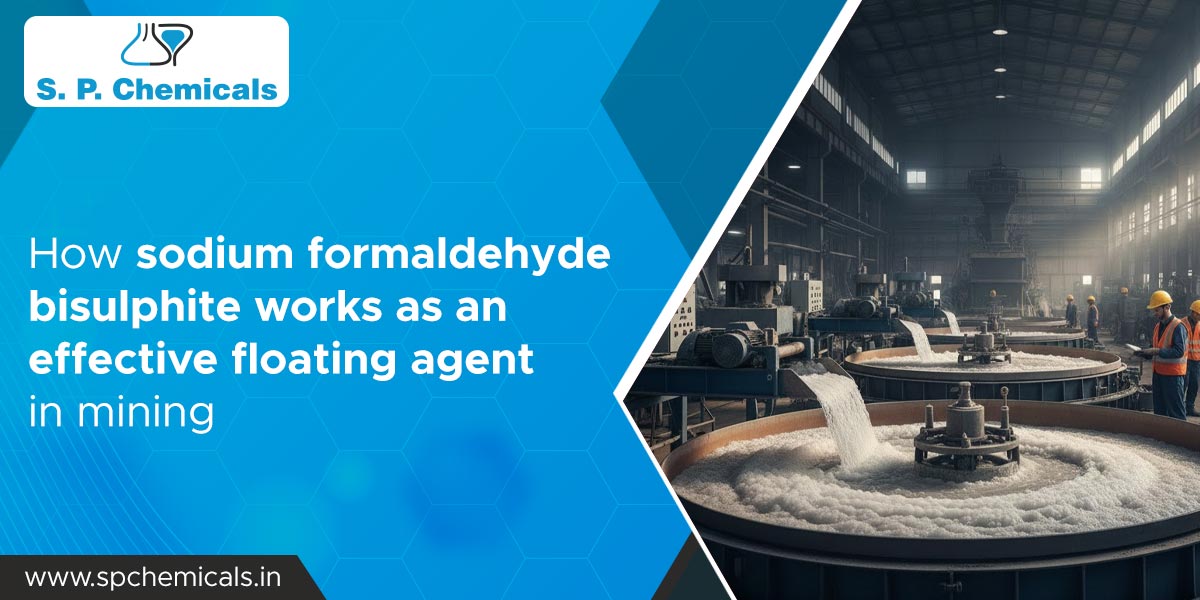
At S.P. Chemicals, we have spent many years working with process chemicals that shape key industries. Mining has always held a special place for us because it shows how the right chemical can bring real change. When we speak with our clients in mining, we hear the same need again and again, strong performance, steady yield, and fewer losses during ore separation. This is where sodium formaldehyde bisulphite/bisulfite enters the conversation, and why we believe it plays such an important part in today’s mineral recovery steps.
We have seen mines struggle when the ore fails to float as expected. Each loss feels like wasted effort, wasted time, and wasted cost. Our aim has always been to support teams on the ground with chemicals that make their daily tasks lighter, safer, and more stable. When the right floating aid works well, the impact shows up fast. Output rises, stress falls, and progress feels steady again. That moment matters to us because it tells us we helped someone achieve what seemed hard to reach.
Why Flotation Needs The Right Chemical Push?
Mining depends on separation. Ores do not rise to the surface on their own. Each mineral has a different nature, weight, and surface behaviour. Some cling to water. Some fight it. Without guidance, particles stay mixed, and the plant cannot sort what it needs from what it does not. Flotation tries to solve this by pushing selected minerals to the surface so they can be collected with ease.
But flotation works only when the chemical we choose knows how to influence surfaces. The agent must help the right particles attach to air bubbles. It must block unwanted particles. It must respond well to the plant’s water quality, pH level, and slurry movement. One mismatch, and the separation feels weak. We have watched teams lose hours adjusting their flow because the chemistry in the tank did not match the behaviour of the ore.
How The Floating Action Begins?
The float step starts with a simple idea: lighter particles will rise when air passes through the slurry. But this lift does not happen by weight alone. The surface of each particle must accept the air bubble. If the surface keeps rejecting the bubble, nothing floats. So, we turn to chemistry to make this acceptance stronger.
With the right treatment, the mineral surface becomes more “bubble-friendly.” This is where our work with S.P. Chemicals has given us deep insight. We have tested countless batches, ore samples, and water profiles to see how the float step behaves with different supporting chemicals. Over the years, we understood that the lift becomes steady only when the agent helps condition the slurry so that air has a fair chance to attach to the target ore.
Why This Chemical Stands Out?
When we work with mining clients, we see how much value they place on reliability. No one wants sudden drops in grade. No one wants unstable froth. We need a chemical that keeps the float layer firm and steady as the minerals rise. That is why we turn to a floating agent for mining applications that supports clean separation under varied plant conditions. Its structure helps build a stable surface so that the target ore stays lifted until it can be collected.
This control matters the most in ores that carry complex sulphide mixes. In those cases, we have found that the agent does more than help minerals rise. It supports smoother conditioning, cleaner interaction with air, and less interference from waste material. When we see this shift on the plant floor, we know that the chemical is doing what it should, helping the operators trust every batch that enters the cell.
How This Agent Improves The Full Separation Cycle?
We understand that flotation is not just one step. It is a chain of linked actions. If one step shakes, the whole chain shakes with it. Our mining partners often tell us how stressful it can feel when froth collapses, bubbles break early, or ore slips back into the slurry. Each slip forces a repeat, and each repeat takes away from the final yield.
A well-designed flotation aid supports a smooth chain. It improves the way particles behave as the slurry moves. It reduces the load on the operators who stand by the tanks. It helps keep the line running without constant corrections. Many of our long-term clients say that when their float step becomes stable, their confidence in the full plant rises as well. No one forgets that sense of relief when a process that once felt hard finally becomes easy again.
How Chemistry Strength Supports Performance?
At S.P. Chemicals, we understand not only what a float agent must do, but also what it must avoid doing. An agent should not weaken at higher pH. It should not create harsh reactions. It should not disturb other inputs in the cell. When these risks stay low, the separation stays clean.
Some users also choose this chemical for its dependable nature in other fields. That includes use as a reducing agent for chemical processing, a need that often comes up in plants that handle food and industrial lines side by side. Others value its stable role as a chemical preservative for photography, where clarity and purity matter more than anything else.
Purity Grades And Supply Matters?
We often hear from plant managers who want a clean supply route with strong quality checks. To meet these needs, we offer batches that match strict purity demands. For those who want top-end grades, we support them as a sodium formaldehyde bisulphite extra pure supplier in India. For global clients who need steady and secure export flows, we stand with them as a sodium formaldehyde bisulphite pure grade exporter in India.
Some plants also prefer working with ready-to-dose liquids. For them, we supply our trusted sodium formaldehyde bisulphite 45% solution, which offers steady performance with easy handling. Each plant works differently. Our role is to make sure our clients can choose what suits them best.
Why The Mining Sector Trusts This Solution?
When we speak with mining teams, one thing stays clear. They care about outcomes. They want better recovery. They want less waste. They want a steady float that does not break when the load shifts. The right chemical helps them achieve this with less stress behind every shift.
We feel proud when our clients tell us that S.P. Chemicals has made their work smoother. It reminds us why we keep improving our batches year after year. We do not chase trends. We focus on what gives real value to the people who use our chemicals every day.
Closing Thoughts:
Mining is hard work. It tests patience, skill, and focus. When chemistry steps in with the right support, the job feels lighter. That is what we hope to deliver each day. By offering chemicals that help ore float with confidence, we help our partners push towards higher yield and more stable runs.
S.P. Chemicals will continue to stand beside the mining sector as it grows. We will keep refining our inputs and supporting our clients with clarity and care. When the flotation cell runs steady, and the recovery rises, we feel the joy of shared progress, a feeling that keeps us moving forward with purpose.

